
Ancient Roman coins
14k+ coins · up to $50,000
Browse Catalogue
Explore popular collecting categories, from ancient Roman to rare American.


Want to check your coins value? Get it evaluated first, then list to verified buyers.

MOBILE APP
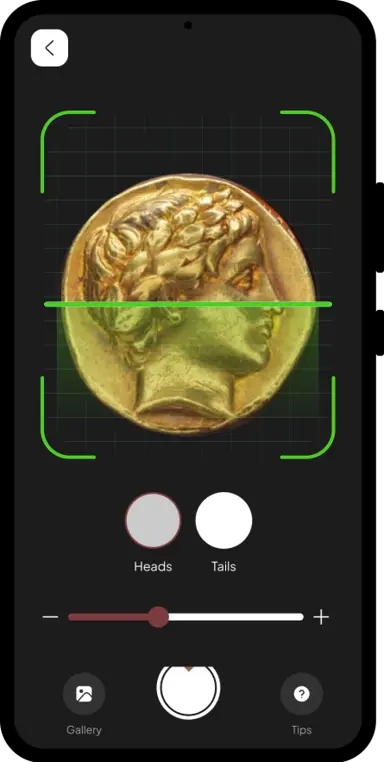
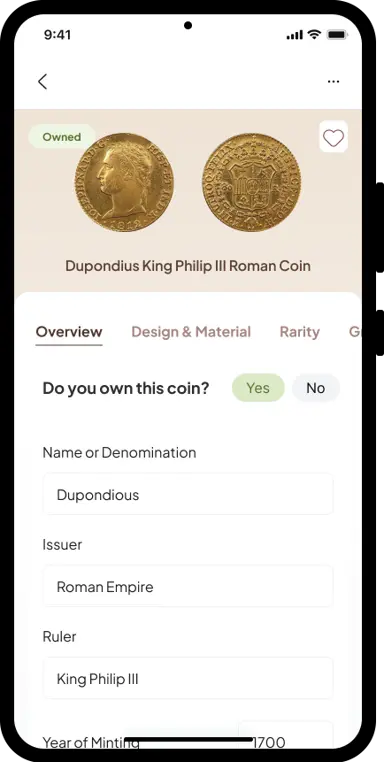
Identify coins using your camera. Your collection syncs across devices.
1M+
Daily users
4.3+★
User feedback rating
1.5M+
Items cataloged
20K+
Community members


Estimated Value
No recent market data yet
Name or Denominations
50 Dollars
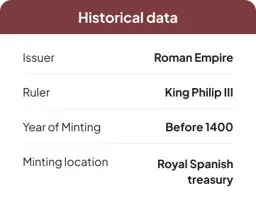
Issuer
California (United States (pre-federal and private/territorial))
Ruler
Federal republic (1789-date)
Year of Minting
1852
Currency
Dollar
Shape
Octagonal (8-sided)
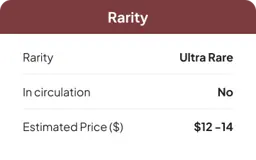
Rarity
Ultra rare
Weight
NA
Diameter
NA
Thickness
NA
Material
Gold (.900)
Shape
Octagonal (8-sided)
Edge Type
NA
Technique
Milled
Front design
Heraldic eagle, banner above inscribed with purity, country name surrounding, within beaded inner circle. Additional inscription between circle and edge
Back design
NA
Year of Minting
1852
Ruling authority
Federal republic (1789-date)
Mint location
Moffat & Co. San Francisco , United States (1849-1853)
Mint mark
NA
Orientation
NA
Inscriptions
Obverse: UNITED STATES ASSAY OFFICE OF GOLD SAN FRANCISCO CALIFORNIA UNITED STATES OF AMERICA 900 THOUS LIBERTY FIFTY DOLLS. 1852
Context
1852 $50 Assay Office Fifty Dollar, 900 Thous. MS63 PCGS. K-14, High R.5. In a pattern that would repeat worldwide wherever major Gold deposits were found -- often in conjunction with Silver, Copper, and other minerals -- the earliest miners would have to content themselves with using 'pinches' of Gold dust of approximated values for commercial transactions. Enterprising private Assayers-Coiners would soon move in, however, assaying Gold Dust (sometimes) more reliably and producing coins and/or ingots that would be more commercially viable. The longest-lived of such Assayers-Coiners would be, of course, those whose products were perceived to be of good value. These unofficial entities would sometimes be supplanted (or supplemented) by semiofficial or official Mints when the supply and demand for gold coinage was sufficiently long-lasting. This is a theme with variations that played out not only in California but also in Georgia, North Carolina, Colorado, Nevada, Australia, Canada, Yukon Territory of Alaska, South Africa, and Brazil during the late 18th to the early 20th centuries. John L. Moffat sailed aboard the bark Guilford from New York in February 1849, opening an assay office in San Francisco in June of that year with partners Messrs. Curtis, Perry, and Ward. Moffat & Co. made rectangular ingots as well as five dollar and ten dollar gold coins beginning in September 1849. Other early private coiners, such as Norris, Gregg, & Norris, Miners' Bank, and several others, saw their products rapidly fade from commercial circulation due either to poor quality or the perception thereof. Attempts were made in 1850 to outlaw the production of private gold coinage in California by making it a misdemeanor; those attempts failed, owing to the scarcity of circulating gold coins and ingots. Unfortunately, underweight and sometimes counterfeit gold bars and ingots were prevalent, the combined results of greed, incompetence, and fraud. In November 1850 the popular newspaper Alta California announced the appointment of Augustus Humbert as United States assayer of gold 'with the proprietors of some well established assaying works, now in successful operation in California.' That unidentified firm was, of course, Moffat & Co., the most prominent, successful, and longest-lived of the California Territorial gold coiners. The firm began issuing rectangular gold ingots in 1849, of which three denominations are known today. Moffat & Co. also issued five and ten dollar gold coins, and later twenty dollar gold pieces, that closely imitated the federal style, save for replacing Liberty on the headband with MOFFAT & CO. John L. Moffat retired in February 1852, and the remaining partners, Curtis, Perry, and Ward, reorganized as the U.S. Assay Office. After the appointment of Augustus Humbert as United States assayer in late 1850, Humbert stamped his name and the U.S. government imprint on the gold ingots of Moffat & Co., attesting to their purity and value. The Moffat & Co. and U.S. Assay Office enterprise was, in effect, a provisional U.S. branch mint. Their fifty dollar octagonal gold pieces, as well as other smaller-denomination coins issued from 1851 through 1853, passed at par with federal gold coins (although the latter were seldom seen). The Humbert and U.S. Assay Office coins were the first Territorial gold coins that bore the official imprint of the United States of America and of its official assayer, Augustus Humbert. This gave the Humbert-Assay Office fifty dollar pieces and other denominations a cachet and respectability that coins from private, unofficial coiners simply could not match. The 900 fineness Assay Office fifty dollar coins, despite their 1852 date, were struck in January and February 1853 on an emergency basis. During this period, other private coiners had ceased operations, and yet the San Francisco Mint would not open for another year. The planchets were assayed and the coins struck to the federal 900 fine standard. The 900 fineness Assay Office fifty dollar coins are rarer across all grade levels than the 887 fine pieces, and the present MS63 PCGS example is certainly high within the Condition Census for the issue. PCGS shows two submissions in MS63 with one higher in MS64, and NGC also shows one piece in MS64 (1/14). This piece displays medium yellow-gold surfaces with blended traces of auburn and orange that offer eye appeal and preservation that are nothing short of extraordinary. The peripheral legend Unitied States Assay Office Of Gold San Francisco California is bold all the way around the periphery, and all of the central details are boldly brought up. A few stray marks are minor and as expected on these large, soft gold coins. Small irregularities in the planchet near the edges of each side are as made. A small dig on the reverse between the inner and outer rings at about 9:30 will help pedigree this piece. Listed on page 383 of the 2014 Guide Book. From The Riverboat Collection. (NGC ID# ANHH, PCGS# 10019) © Heritage Auctions
Rarity
Ultra rare
Coin type
Standard circulation
In circulation
No
Demonetized
Yes
Marketplace listings
0

Subscribe to Premium
Unlock more coin details with Premium.