
Ancient Roman coins
14k+ coins · up to $50,000
Browse Catalogue
Explore popular collecting categories, from ancient Roman to rare American.


Want to check your coins value? Get it evaluated first, then list to verified buyers.

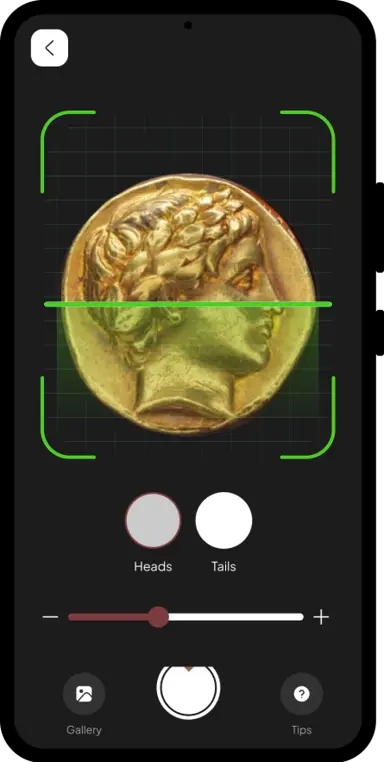
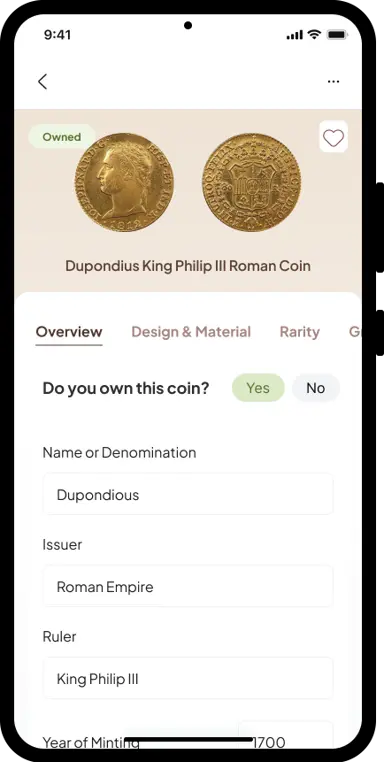
MOBILE APP
Identify coins using your camera. Your collection syncs across devices.
1M+
Daily users
4.3+★
User feedback rating
1.5M+
Items cataloged
20K+
Community members


Estimated Value
No recent market data yet
Name or Denominations
1 Doblon (10 UYP)
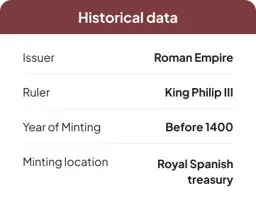
Issuer
Uruguay
Ruler
Oriental Republic of Uruguay (1825-date)
Year of Minting
1870
Currency
Peso (1863-1975)
Shape
Round
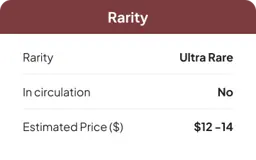
Rarity
Ultra rare
Weight
NA
Diameter
NA
Thickness
NA
Material
Gold plated bronze
Shape
Round
Edge Type
NA
Technique
Milled
Front design
Flagged arms within sprigs, radiant face above, star below
Back design
Value within wreath, date below
Year of Minting
1870
Ruling authority
Oriental Republic of Uruguay (1825-date)
Mint location
NA
Mint mark
NA
Orientation
NA
Inscriptions
Obverse: REPUBLICA ORIENTAL DEL URUGUAY Reverse: LIBRE Y CONSTITUIDA 1 DOBLON 1870
Context
Republic bronze Pattern 1 Doblon 1870. Rare copper pattern struck for the Doblon, a gold denomination which was never struck for circulation. One of the classic rarities of the Uruguayan series, of which only few examples are known, including two gilt bronze or copper examples. A specimen of the latter was referenced by Ricardo Elicabe in the January 1929 issue of the Revista filatelica de la sociedad de comerciantes de sellos postales, printed in Buenos Aires. The law of June 23, 1862 established the gold Doblon, of .917 fineness and a weight of 16.97 grams as the monetary unit, equivalent to 10 silver Pesos of 0.917 fineness and 25.480 grams. The silver Peso was mirrored to the Brazilian 2000 Reis piece struck from 1851 onwards (these pieces were well accepted in Uruguay), but the gold was valued higher in Uruguay then Brazil: hence, the corresponding 20,000 Reis piece was worth slightly more than 10 Uruguay Pesos, namely 10.56 Pesos. Coins struck to the decimal French standard, were of slightly less nominal value when converted to the Uruguayan rate: thus a decimal gold 10 Pesos piece (such as the French 50 Francs or the Chilean condor) was worth 9 Uruguayan Pesos, while a silver decimal Peso was worth 90 Uruguayan Centesimos. These rather confusing conversions had to be made in everyday transactions since Uruguay struck no gold or silver coins for the first 15 years after the 1862 law was proclaimed. Evidently, the aforementioned gold and silver foreign coins provided a sufficient media for the higher transactions since in that 1862-1877 period, the only coins minted in Uruguay were the bronze minors struck in 1869, struck in Paris and Birmingham ('A' and 'H' mintmarks respectively). shortly after those issues, a few trials of the silver and gold denominations were struck, all dated 1870, but no such regular coins were issued. all these 1870 pieces look French in manufacture and they were most probably struck at the Paris mint. Finally, on December 30, 1876 a resolution was passed to call for proposals to strike up to 1,000,000 pesos in the decimal standard. These correspond to the 1877-1878 issued struck in Paris. Although the 1862 law was never materialized into regular issue coins (save for the common 1869 bronze issues), it left a treasure for the numismatic community with the patterns dated 1870. Of the aforementioned copper trials of the Doblon,
Rarity
Ultra rare
Coin type
Patterns
In circulation
No
Demonetized
Yes
Marketplace listings
0

Subscribe to Premium
Unlock more coin details with Premium.