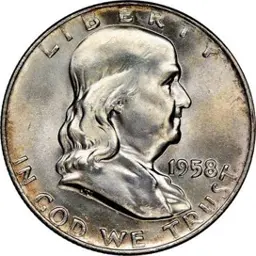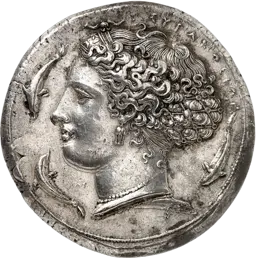

Ancient Roman coins
14k+ coins · up to $50,000
Browse Catalogue
Explore popular collecting categories, from ancient Roman to rare American.



Want to check your coins value? Get it evaluated first, then list to verified buyers.

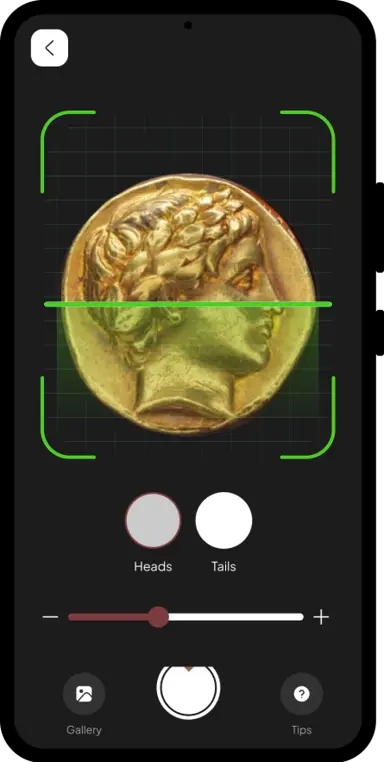
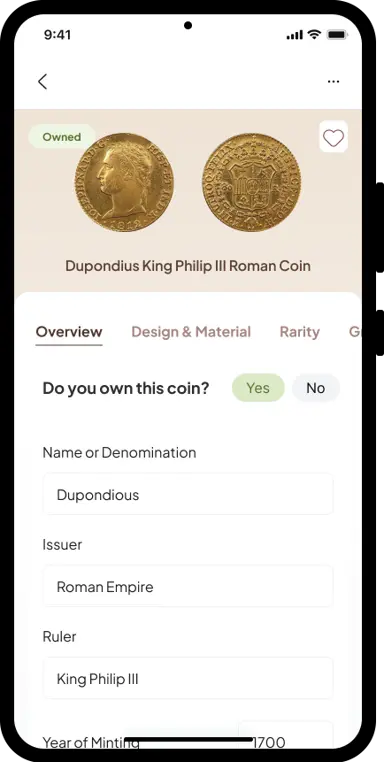
MOBILE APP
Identify coins using your camera. Your collection syncs across devices.
1M+
Daily users
4.3+★
User feedback rating
1.5M+
Items cataloged
20K+
Community members


Estimated Value
No recent market data yet
Name or Denominations
1 Farthing (1⁄960)
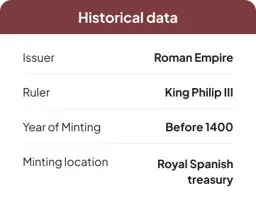
Issuer
England (United Kingdom, British Overseas Territories and Crown Dependencies)
Ruler
James II (1685-1688)
Year of Minting
1687
Currency
Pound sterling (1158-1970)
Shape
Round
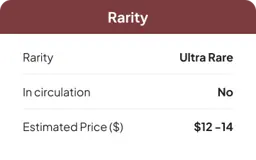
Rarity
Ultra rare
Weight
5.7 g
Diameter
23.5 mm
Thickness
NA
Material
Bimetallic: copper centre in tin ring (copper plug)
Shape
Round
Edge Type
Incuse date
Technique
Milled
Front design
Draped bust of King James II facing right, legend around.
Back design
Seated figure of Britannia facing left, holding spear in left hand, olive branch in right, shield with Union flag resting at left, legend around.
Year of Minting
1687
King
James II (1685-1688)
Mint location
NA
Mint mark
NA
Orientation
Coin alignment ↑↓
Inscriptions
Obverse: IACOBVS SECVNDVS Reverse: BRITANNIA
Context
The original standard weight for these pieces was 80 to the pound avoirdupois (1/5 ounce or 87.5 grains each). Following is an excerpt from the Department of Special Collections at the University of Notre Dame Libraries: 'James II (1685-1688) started the production of a plugged tin halfpenny in 1685 and continued production through 1687. During his reign the warrant to mint tin coins was renewed by Duncome, Hoare and Neale on March 11, 1686. A few tin farthings were minted in 1684 with larger quantities produced in 1685-1687. Tin was a much less expensive metal than copper so that the intrinsic value of these coins was far lower. This yielded higher minting profits for the king, but the low intrinsic value turned public opinion against the coins. In order to make these tin coins more acceptable James returned to the heavier weight of 40 halfpence to the pound, producing an average weight of 175 grains per halfpenny. As tin was cheap and readily assessable, a number of counterfeit halfpence appeared in circulation. James used a bust left for his gold and silver coins but like Charles used the opposite profile on his halfpence and farthings, which displayed a bust right.'
Rarity
Ultra rare
Coin type
Standard circulation
In circulation
No
Demonetized
Yes
Marketplace listings
0

Subscribe to Premium
Unlock more coin details with Premium.