
Ancient Roman coins
14k+ coins · up to $50,000
Browse Catalogue
Explore popular collecting categories, from ancient Roman to rare American.


Want to check your coins value? Get it evaluated first, then list to verified buyers.

MOBILE APP
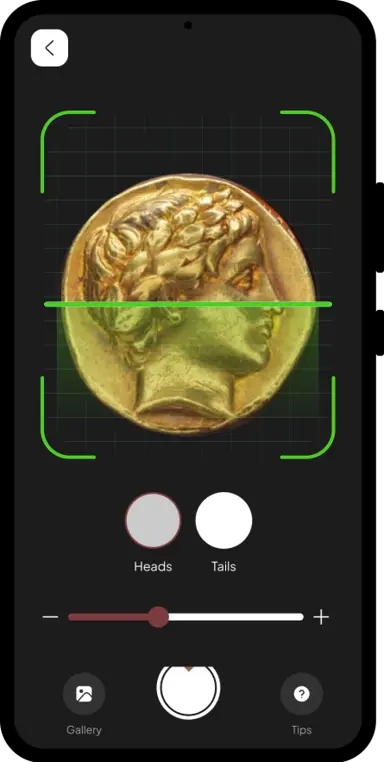
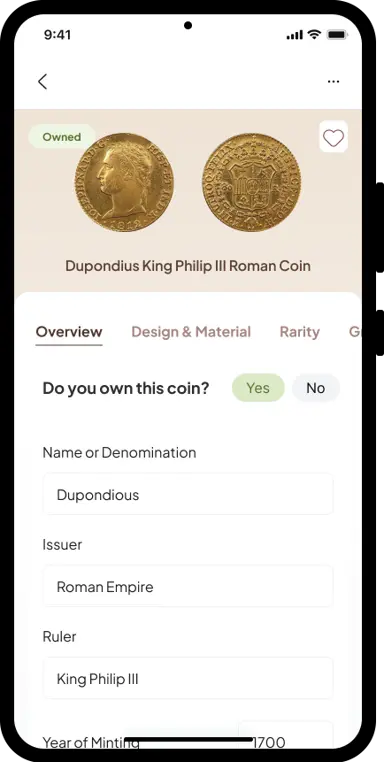
Identify coins using your camera. Your collection syncs across devices.
1M+
Daily users
4.3+★
User feedback rating
1.5M+
Items cataloged
20K+
Community members


Estimated Value
Based on recent market data

$5,000,000
Name or Denominations
1870-S $3
Issuer
United States
Ruler
NA
Year of Minting
1870
Currency
Dollar (1792-date)
Shape
Round
Rarity
Ultra rare
Weight
5.02 g
Diameter
20.5 mm
Thickness
NA
Material
90% Gold, 10% Copper
Shape
Round
Edge Type
Reeded
Technique
Struck
Front design
Liberty with flowing hair, wearing a coronet inscribed with "LIBERTY", facing left.
Back design
A wreath of cotton and corn, with the denomination "3 DOLLARS" in the center and "UNITED STATES OF AMERICA" around the edge.
Year of Minting
1870
Ruler
NA
Mint location
San Francisco
Mint mark
S
Orientation
Coin alignment
Inscriptions
LIBERTY | UNITED STATES OF AMERICA | 3 DOLLARS
Context
: The Enigmatic 1870-S Three-Dollar Gold Piece The 1870-S Three-Dollar Gold Piece (#7992) is a legendary numismatic rarity whose origin is draped in historical significance. However, its presence in private hands has long called into question the specific details of the coin’s creation. The story began on May 25, 1870 , during a Masonic ceremony for the second San Francisco Mint . A copper casket was interred in the northeast cornerstone containing a collection of contemporary rarities, including an 1870-S $3 gold coin struck specifically for the occasion using modified dies. Prior to the creation of this piece, the Three-Dollar Gold denomination had not been struck at the San Francisco Mint since 1860. Furthermore, no other Three-Dollar Gold pieces would be struck there for the remaining duration of the series' production. For decades, the specimen sealed within the cornerstone was assumed to be the sole example in existence. The Mystery of the Second Coin In 1907, the hobby was stunned when dealer H.T. VanCamp advertised a second 1870-S $3 gold piece in The Numismatist . His ad claimed: “HERE IS A COIN ALL ALONE BY ITSELF. Never in circulation - never before in the market. With the Coin is an interesting little history by the Coiner who made it.” The ad drew the attention of future Treasury Secretary William H. Woodin , himself a major collector. After his purchase, Edgar H. Adams described the coin's original story in more detail: “Only one specimen of this coin is known, this being now in the possession of a well-known New York collector [William H. Woodin]. It is said that the dies were used by a coiner of the San Francisco Mint to strike two specimens in 1870. One of those was placed in the cornerstone of a public building of that city. The mint records do not mention the issue of a coin of this denomination and letter.” Without the benefit official Mint records detailing the production of 1870-S Three Dollar Gold Coins and because the San Francisco Mint's cornerstone remained sealed, numismatists were baffled. It took over a century for Nancy Oliver and Richard Kelly (2004) to uncover the truth: Joseph Breck Harmstead , a coiner at the San Francisco Mint, had hand-carved the "S" mintmark onto a die and struck two examples. The First: Placed in the cornerstone. The Second: A gift for his niece, Georgine, which eventually reached VanCamp. Georgine mounted the future multiple-million dollar rarity on a piece of jewelry. A crudely cut 893 is etched on the reverse in the space above the opening of the wreath. Researchers Richard Kelly and Nancy Oliver have propsed that the numbers refer to the coin’s gold fineness, even though gold was mandated to be .900 fine. Gold coin expert Doug Winter is skeptical of this explanation, noting no definitive explanation exists. The "interesting history" that VanCamp wrote about in his 1907 ad apparently came in the form of Harmstead's original letter to his niece. While this letter allegedly verified the coin’s origin, it has since disappeared. Sadly, the letter no longer exists, and there is no known transcription of its contents. Perhaps it was destroyed to enhance the coin's "uniqueness" or to cover for its potentially unauthorized production. A Star-Studded Provenance Known as the "Eliasberg-Bass Specimen," this unique-in-private-hands rarity has been held by the most legendary names in coin collecting: William H. Woodin, Waldo Newcomer , "Colonel" E.H.R. Green , Louis E. Eliasberg, Sr. , and Harry W. Bass, Jr. The coins is currently ranked #17 in PCGS Hall of Fame dealer Jeff Garrett’s 100 Greatest U.S. Coins . As the "holy grail" for $3 gold collectors, it remains a cornerstone—literally and figuratively—of American numismatic history. * * *
Rarity
Ultra rare
Coin type
Three Dollar (1854-1889)
In circulation
NA
Demonetized
No
Marketplace listings
0

Subscribe to Premium
Unlock more coin details with Premium.