
Ancient Roman coins
14k+ coins · up to $50,000
Browse Catalogue
Explore popular collecting categories, from ancient Roman to rare American.


Want to check your coins value? Get it evaluated first, then list to verified buyers.

MOBILE APP
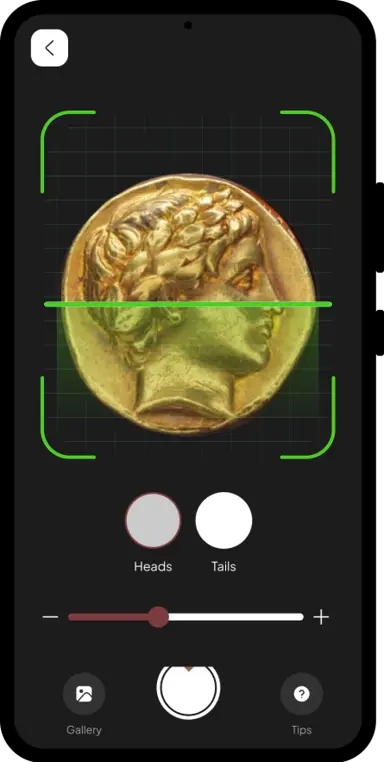
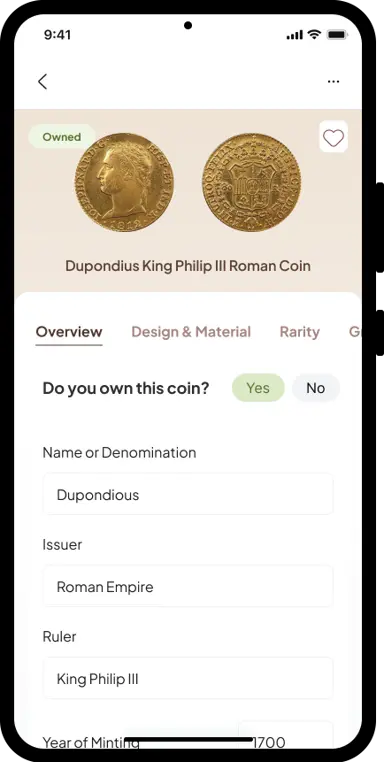
Identify coins using your camera. Your collection syncs across devices.
1M+
Daily users
4.3+★
User feedback rating
1.5M+
Items cataloged
20K+
Community members


Estimated Value
Based on recent market data

$1,892,307.69
Name or Denominations
1792 1C Judd-1, Silver Center, BN
Issuer
United States
Ruler
NA
Year of Minting
1792
Currency
Dollar (1792-date)
Shape
Round
Rarity
Rare
Weight
4.48 g
Diameter
24 mm
Thickness
NA
Material
Copper
Shape
Round
Edge Type
Reeded
Technique
Struck
Front design
Liberty, as a woman, facing left, with flowing hair, wearing a Phrygian cap. She is holding a pole with a liberty cap on top. The inscription "LIBERTY" is above her head, and the date "1792" is below.
Back design
A wreath of laurel leaves tied with a ribbon, enclosing the denomination "1/100" and the inscription "UNITED STATES OF AMERICA".
Year of Minting
1792
Ruler
NA
Mint location
Philadelphia
Mint mark
NA
Orientation
Coin alignment
Inscriptions
LIBERTY | 1792 | UNITED STATES OF AMERICA | 1/100
Context
: 1792 saw a flurry of activity aimed at establishing a Mint in America. Congress passed a Mint Act, chose a Director, purchased a plot of land, erected a building, and hired employees. Four prototypes of the One Cent piece were tested: a large copper piece (the "Birch" Cent), a smaller copper piece with a silver center (the Silver-Center Cent"), another of the same size (the Fusion Alloy Cent, in which the silver and copper were melted together), and another of the same size in pure copper. The Silver-Center Cent answered the concerns of then Treasury Secretary, Alexander Hamilton, who felt that a billon coin could be too easily counterfeited. However, the technical difficulties in producing quantities of the Silver-Center Cent remained. Although no written evidence remains to record the testing, clearly the large, pure copper piece was favored, as this was the chosen format when production of Large Cents began in 1793. When Frank Stewart demolished the original Mint building circa 1924, he discovered some blank planchets for the Silver-Center Cents (missing the silver center). In 1994, Anthony Terranova discovered a struck Silver-Center Cent missing the silver center. The several experts who examined this piece believe that the silver center was never included and that the coin may have been a test piece to show the size of the new coin. The weight of this discovery piece was 72.6 grains. The planchet diameter measured 29.3 millimeters on the vertical axis and 29.2 millimeters along the horizontal axis. Planchet thickness varied from 1.3 to 1.4 mm. Judd considered all the plain edge pieces to be counterfeits. Credit for the design and engraving of the Silver-Center Cent normally goes to Henry Voigt, the first Chief Coiner of the U.S. Mint, however this assignment is subject to interpretation and is probably incorrect. The engraving skills shown on the Silver-Center Cent exceed those possessed by someone with no previous engraving experience. At the 2015 American Numismatic Association Convention, PCGS began designating all Silver-Center Cents as SP (Specimen) instead of the previous (MS) Mint State. Sources and/or recommended reading: "United States Pattern, Experimental and Trial Pieces" by J. Hewitt Judd, M.D. "Walter Breen's Complete Encyclopedia of United States and Colonial Coins" by Walter Breen "United States Patterns And Related Issues" by Andrew W. Pollock III "Silver Center Cents - Patterns Lay Claim To First Struck At Mint" by Paul Gilkes, COIN WORLD, February 21, 2000, pp. 78-79
Rarity
Rare
Coin type
Patterns (1792-1859)
In circulation
NA
Demonetized
No
Marketplace listings
0

Subscribe to Premium
Unlock more coin details with Premium.