
Ancient Roman coins
14k+ coins · up to $50,000
Browse Catalogue
Explore popular collecting categories, from ancient Roman to rare American.


Want to check your coins value? Get it evaluated first, then list to verified buyers.

MOBILE APP
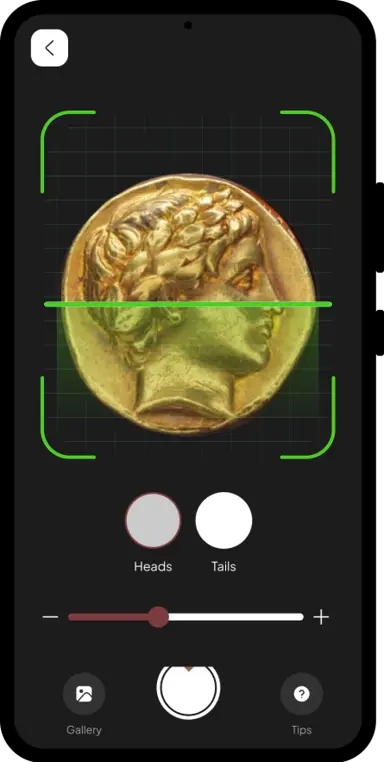
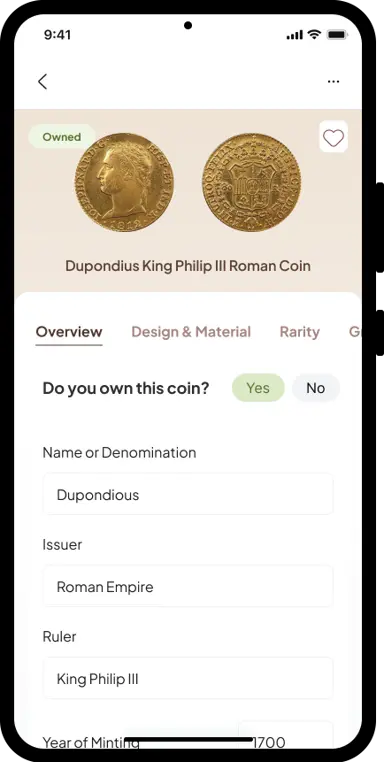
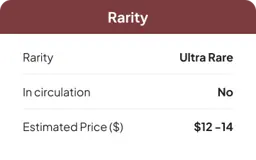
Identify coins using your camera. Your collection syncs across devices.
1M+
Daily users
4.3+★
User feedback rating
1.5M+
Items cataloged
20K+
Community members


Estimated Value
Based on recent market data

$603,750
Name or Denominations
1792 1C J-2, BN
Issuer
United States
Ruler
NA
Year of Minting
1792
Currency
Dollar (1792-date)
Shape
Round
Rarity
Rare
Weight
4.48 g
Diameter
24 mm
Thickness
NA
Material
Billon
Shape
Round
Edge Type
Reeded
Technique
Struck
Front design
Liberty, as a woman, facing left, with flowing hair, wearing a Phrygian cap. She is holding a pole with a liberty cap on top. The inscription "LIBERTY" is above her head, and the date "1792" is below.
Back design
A wreath of laurel leaves tied with a ribbon, enclosing the denomination "1/100" and the inscription "UNITED STATES OF AMERICA".
Year of Minting
1792
Ruler
NA
Mint location
Philadelphia
Mint mark
NA
Orientation
Coin alignment
Inscriptions
LIBERTY | 1792 | UNITED STATES OF AMERICA | 1/100
Context
: 1792 saw a flurry of activity aimed at establishing a Mint in America. Congress passed a Mint Act, a Director was chosen, a lot was purchased, a building was erected, and employees were hired. While the Mint Act gave directions as to which denominations were to be struck, apparently the Mint officials felt they had some discretion in choosing formats and designs. For the One Cent piece, which was to be one of the main coins produced in 1793, four types were tested: a large copper piece (the "Birch" Cent), a smaller copper piece with a silver center (the Silver-Center Cent"), another of the same size (the Fusible Alloy Cent, in which the silver and copper were melted together), and another of the same size in pure copper. Although no written evidence remains to record the testing, clearly the large, pure copper piece was favored, as this was the chosen format when production of Large Cents began in 1793. Judd's statement that the edges of these coins are diagonally reeded may be incorrect; all examples observed by researcher Saul Teichman have vertically reeded edges. Judd and Breen considered all the plain edge pieces to be counterfeits. Judd 2 is the "non-Silver Center" version of Henry Voight's cent pattern. Judd 2 is known in two versions: one version made of pure copper and another version where a small amount of silver was combined with copper to create a billon alloy (sometimes referred to as "fusible alloy". The only way to tell the two versions apart is by metallurgical analysis. Fusible Alloy examples: Only one Fusible Alloy Cent is known. Breen claimed that the Pine Tree-ANA example had been chemically(?) tested and found to contain silver, but no silver was found in this coin when it was tested later on behalf of the cataloguer of the Norweb collection. Few of the so-called "Copper" 1792 Cents have been tested, so more "Fusible Alloy" Cents may exist. - Harmer Rooke 11/1969 - New Jersey private collection. According to the Norweb cataloguer, this piece was tested using x-ray flourescence and found to contain silver. Pure Copper examples: The composition of many of the coins listed below has not been tested. Thus, some may be "Fusible Alloy" (a mixture of copper and silver) instead of being pure copper Judd plate coin (not plated in the 7th edition) - National Numismatic Collection at the Smithsonian Institution (called "finest" by Saul Teichman) "EF-40" - Lorin Parmelee, June 1890, Lot 6 - Virgil M. Brand - B. Max Mehl, January 11, 1936 - B&M "Norweb" 11/1988:3393, "Second Finest Known, 62.2 grains, 22.4 mm, 360°", $35,200.00 PCGS VF-30 - Oliver Wolcott, Jr? - Wolcott family - Goldbergs 02/2005:806, sold for $437,000.00 Very Fine - Seavey, 1873 - E. Maris, 1886, Lot 146 - T.H. Garrett - Bowers & Ruddy's "Garrett Collection" sale, March 1981:2348, "63.1 grains", $28,000.00 PCGS VG-10 - Lauder:234 (pedigreed incorrectly there) - Dana Linett, sold for $15,000 in 1983 - David Henderson - Bowers and Merena "Rare Coin Review, No. 53" 10/1984, page 16 - Goldbergs "Benson Part 1" 02/2001:151, $57,500.00 - Southern Collection - Simspon Collection Hinman - Paramount "Century" 04/1965:50 - Bowers & Ruddy "Rare Coin Review, No. 19", 1974, p. 17 - Bowers & Ruddy "Rare Coin Review, No. 20", 1974, p. 14 - Douglas Robins, Inc. (Coin World, December 4, 1974) - Pine Tree 02/1975:59 (not Lot 69 as has been cited on occasion) - American Numismatic Association 70.2 grains. The authenticity of this piece has been questioned in the past but it is believed to be authentic by Tom DeLorey and Walter Breen. Breen claimed that this piece was tested chemically and found to contain silver, but this was refuted in a later test done on behalf of the cataloguer of the Norweb collection. - W.S. Appleton - Massachusetts Historical Society (illustrated at Crosby Plate X - 12) - American Numismatic Society - Adams-Woodin plate coin - L. R. Lohr (1961) - Bowers & Ruddy "River Oaks" 11/1976:909 - Stack's 01/1987:476 Sources and/or recommended reading: "United States Pattern, Experimental and Trial Pieces" by J. Hewitt Judd, M.D. "Walter Breen's Complete Encyclopedia of United States and Colonial Coins" by Walter Breen "United States Patterns And Related Issues" by Andrew W. Pollock III www.uspatterns.com/j2p2.html
Rarity
Rare
Coin type
Patterns (1792-1859)
In circulation
NA
Demonetized
No
Marketplace listings
0

Subscribe to Premium
Unlock more coin details with Premium.